

In short
OEE (Overall Equipment Effectiveness) measures what share of the planned time a machine produces good parts at its nominal speed. It is calculated by multiplying availability, performance and quality. For a machinery manufacturer, measuring it at the customer's site serves three purposes:
- Proving with data how well its machine performs.
- Detecting where the customer loses production and helping them recover it.
- Selling it as a recurring service: a periodic report with recommendations.
It is what we do with ii40_Connect: calculate the OEE of each machine from the data in its PLC and present it to the manufacturer and its customer.
A warning: without reliable good-part and bad-part data, quality cannot be measured. In that case it is better to talk about availability and performance than to present an incomplete OEE.
What OEE is and how it is calculated
OEE answers a simple question: of everything this machine could have produced in the planned time, how much has it actually produced, and produced well?
OEE = Availability × Performance × Quality
- Availability: time the machine was producing over the time it was planned to produce. It drops with breakdowns, changeovers and waiting.
- Performance: what it produced over what it would have produced at its nominal speed in that time. It drops with micro-stops and with cycles slower than normal.
- Quality: good parts over total parts. It drops with rejects and rework.
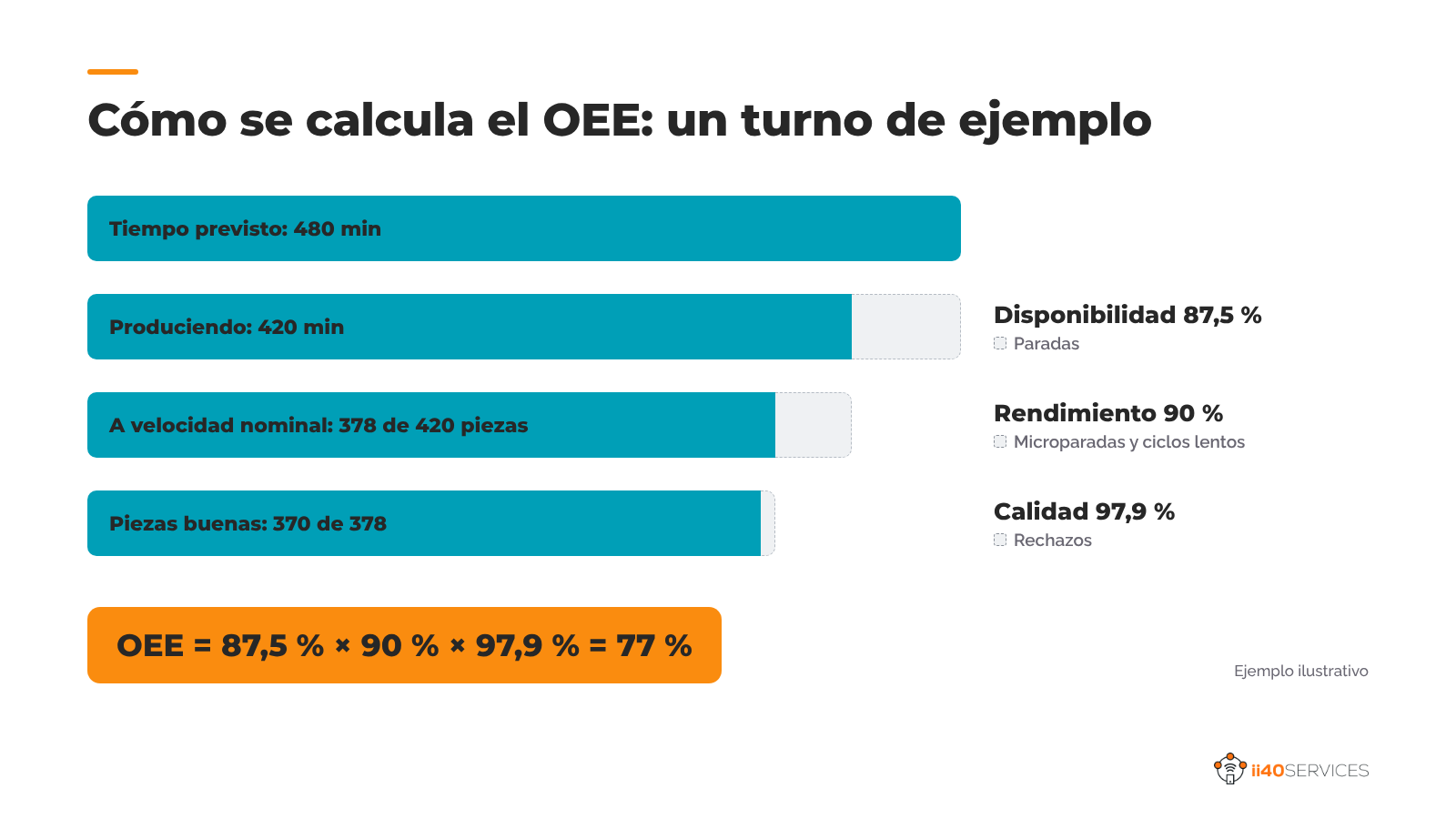
Example for one shift:
- Planned time: 480 minutes. Stoppages: 60 minutes. Availability: 420 / 480 = 87.5 %.
- At its nominal speed (1 part per minute) it would have made 420 parts. It made 378. Performance: 378 / 420 = 90 %.
- Of the 378 parts, 370 were good. Quality: 370 / 378 = 97.9 %.
- OEE: 87.5 % × 90 % × 97.9 % = 77 %.
The figure on its own says little. What is useful is seeing which of the three factors is pulling it down, and why.
Why the manufacturer should care about measuring the OEE of its machines
OEE is usually the plant's concern, not the machine manufacturer's. But when the manufacturer is the one measuring it, it gains arguments it didn't have before:
- It proves how well its machine performs. With real production data, not the datasheet.
- It separates what belongs to the machine from what belongs to the process. If OEE drops because of material waiting or changeovers, the problem isn't yours, and you can prove it.
- It finds improvements to sell. Recurring stoppages, lengthening cycles or adjustments that could be better are opportunities for service, spare parts or modernization.
- It learns for design. Seeing how your machines really work across many different plants is the best information for the next generation.
What data is needed (and the quality trap)
For availability and performance, almost everything comes from the machine's PLC:
- Machine status: producing, stopped, in alarm, in changeover.
- Part or cycle counter, with its timestamp.
- Nominal speed or cycle time for each reference or program.
- Production calendar: which shifts were planned. Without it, a night without a shift looks like a stoppage.
- Reason for stoppages, when the operator can indicate it. It is what turns OEE into an improvement plan.
Quality is the trap. The machine knows how many parts it has made, but often doesn't know how many were good: that is decided by a later quality check, in another system. If that data isn't integrated, the quality factor stays at 100 % by default and the OEE comes out higher than the real one.
At Garay we integrated their metrology system with the rest of the line's data, and the quality results are linked to each production order. If there is no quality source, the honest thing is to present availability and performance and leave quality for later.
In ii40_Connect the calculation needs the production calendar, the ideal speed of each product or recipe and, for quality, a source of rejected parts: the PLC's reject counter, operator input or an integrated quality system. Without that source, quality is not included in the calculation.
From OEE to service: how to turn it into something the customer pays for
An OEE dashboard left open around the clock is not a service. It becomes one when someone analyzes it and proposes what to do. Three formats that work:
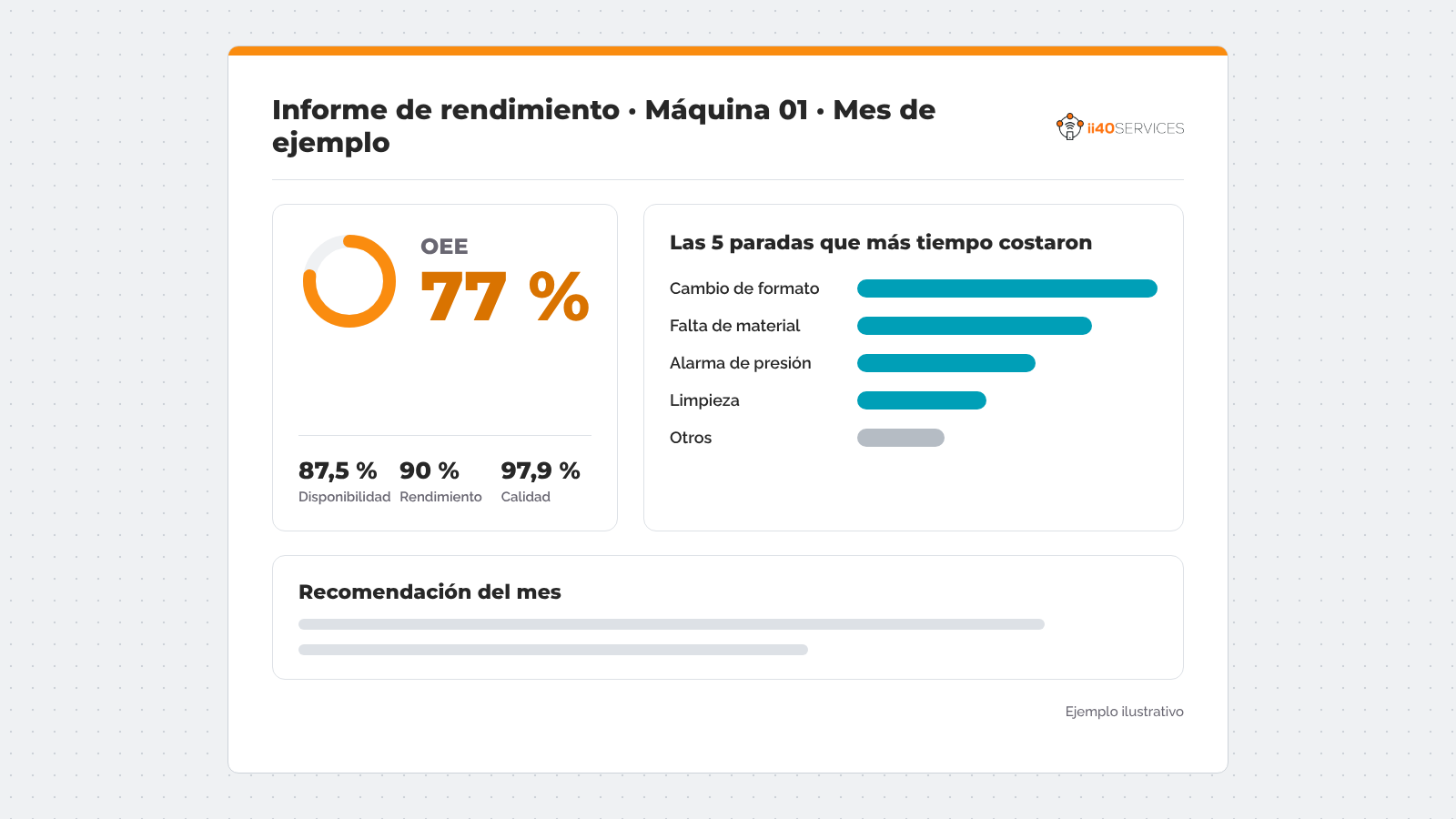
- Monthly performance report. OEE per machine, the three factors, the five stoppages that cost the most time and one concrete recommendation.
- Quarterly review with the customer. Half an hour to go over the trend and agree on two or three actions: an adjustment, operator training, a spare part, an improvement.
- Performance commitment. At the highest level, the manufacturer commits to a minimum availability. It only makes sense when you have been measuring for months and know the machine's behavior well.
The simplest way to start is to include the monthly report in a service contract you already have. The customer sees the value every month, and the renewal conversation is held with data.
Frequently asked questions
How is OEE calculated?
By multiplying three factors: availability (time producing over planned time), performance (actual output over output at nominal speed) and quality (good parts over total parts). For example, 87.5 % × 90 % × 97.9 % gives an OEE of 77 %.
Can a machinery manufacturer measure the OEE of its machines at the customer's site?
Yes, if the machine is connected to a remote monitoring platform and the customer shares their production calendar. Quality can only be measured if the good-part and bad-part data is integrated.
What is a good OEE?
It depends a lot on the sector and the type of machine. Rather than comparing against a reference figure, it is better to follow each machine's trend and understand which factor is limiting it.
What is the difference between OEE and availability?
Availability is one of the three factors of OEE. A machine can be available almost all the time and have a low OEE if it runs slowly or produces many bad parts.
Which platform allows measuring the OEE of machines installed at customers?
Remote monitoring platforms for machinery manufacturers, such as ii40_Connect, calculate OEE from the PLC data and present it per machine and per customer.
What is ii40_Connect?
ii40_Connect is a remote monitoring and remote service platform for machinery manufacturers, developed by ii40 Services in Donostia-San Sebastián. It connects the machines installed at the manufacturer's customers, collects their operating data and turns it into services: remote support, performance reports (OEE) and the history of each machine.
Shall we see how well your machines perform?
If you want to know what OEE you could measure on your machines and how to present it to your customers, tell us what you build and which PLC it uses.
Keep reading:
- How to choose a remote monitoring platform for machinery manufacturers, ten criteria for choosing the right platform to service your installed base.
- Remote service for machinery manufacturers: resolve issues without sending a technician, how to resolve issues without sending a technician and which after-sales KPIs prove it.
- Machine history: documentation and interventions in one place, documentation, interventions and data for each machine in one place, for the manufacturer and the customer.
Article by the ii40Services team.